One reader's rave

"Thanks for the newspaper with your book review. I can’t tell you how impressed I am with this terrific piece of writing. It is beautiful, complex, scholarly. Only sorry Mr. Freire cannot read it!" -- Ailene

Cassie Jaye, the day before I met her at the _Red Pill_ world premiere

Showing posts with label skepticism. Show all posts

Sunday, August 23, 2020

Fake News, or Fake Fact-Checking?

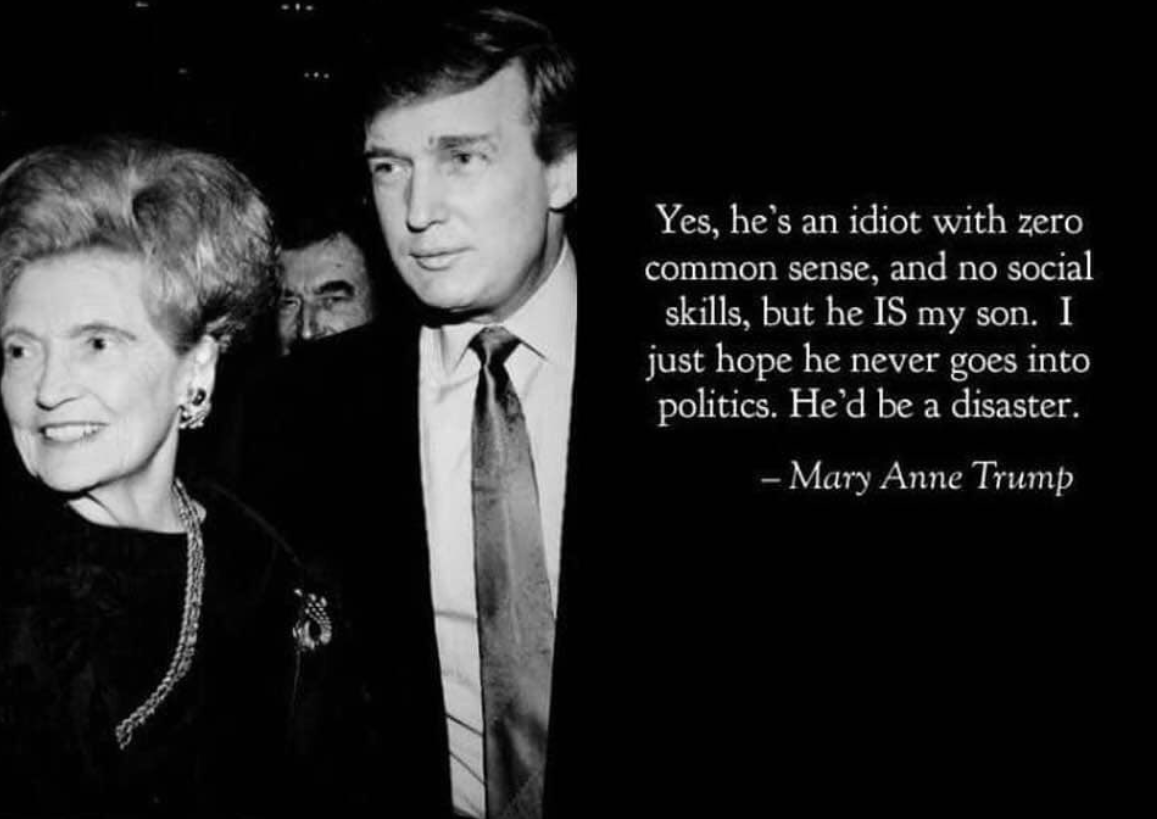
At a meeting last Wednesday, a friend shared an image of a newspaper or magazine clipping with a picture of Donald Trump with his mother, and under the picture a caption quoting his mother saying, "Yes, he's an idiot with zero common sense, and no social skills, but he IS my son. I just hope he never gets into politics. He'd be a disaster."


Preparatory to sharing this, I figured people would like to know which publication it's from. So I did a Web search for "Mary Anne Trump" + "idiot." And what I got was a bunch of pages calling it fake news because they say the quote couldn't be found in any media searches.

Curiously, though, they all show a different meme from the one above -- something much more easily photoshopped, and therefore much more easily dismissed as fake. I was going to post that image below but, strangely, every time I try to do so I get an error message saying the file "must be an image or video," the first of which is exactly what it is. But you can see it here: https://www.snopes.com/tachyon/2019/12/mary-anne-trump.png

Concerning searches for the quote, my friend remarks, "Well upon further review it is not likely a newspaper clipping. More likely a magazine. If they searched newspapers and didn’t find it they would get a false negative. To date it I would suggest it’s mid-80’s, a long time before real online archives that include both pictures AND captions. It’s not formatted like a pull quote so it probably wasn’t in the story."

If anyone reading this knows where the first image is from, please respond in the comments.


Tuesday, July 12, 2011

These Magnets Are Repulsive

I read today on a captivate.com screen that Crowne Plaza hotels are now offering "no-snore" rooms, one of whose features is "magnetic pillows" whose embedded magnets supposedly keep sleepers' airways open. This is of course complete nonsense since magnets have no effect on anything but iron, nickel, and cobalt (and moving electric charges). This hotel chain is shamelessly exploiting some people's scientific ignorance.

I looked for contact information for Crowne Plaza hotels, and the only thing I could find that's not specifically for guest feedback is this address for the Americas office of InterContinental Hotels Group LLC,
of which Crowne Plaza is a part:

InterContinental Hotels Group
3 Ravinia Drive Suite 100
Atlanta, GA 30346-2149

I'm writing them today to call on them to stop promoting pseudoscience!

Saturday, June 19, 2010

Gathering, Not Hunting

I recently hit on another way to take myself out of my mental comfort zone, and tried it today. I knew there was at least one item I wanted to buy at Rite Aid, but instead of going directly to where I might expect to find it, I made myself walk slowly along each of the aisles, simply scanning the shelves to see if there was anything interesting there. If I saw something, I would then consider whether it was something I ought to buy now or sometime soon. This may seem pretty quotidian to some, but for me it wasn't, because my whole life I've shopped exclusively in "hunter" mode, knowing what I planned to get when I went in and aiming straight for it. This fits into my general pattern of needing a well-defined purpose all the time and not easily getting comfortable with non-directive activity. I knew, therefore, that this exercise would be a stretch for me, one that I hope (especially with repetition) will help me learn to be less anxious and more able to live in the moment. The proof that this actually was a stretch lay in how I felt as I was doing it. It was a slightly heady feeling, a bit as if I were floating -- an appropriate metaphor in that I had intentionally let go of the "mooring" of being fixed on a purpose. Also today, in view of my clear pattern of procrastinating about clubbing, I decided that starting immediately I will set aside an amount from each pay deposit for that purpose, so I won't spend it on something else and then have the excuse, "Oh well, I can't afford it now." I intend by this means to ensure I get out to a club once a week, instead of only a few times over the past several months.

Saturday, January 16, 2010

Don't Think of an Elephant!

The guest at this month's PhACT meeting was Kenneth Biddle of the Paranormal Investigators and Research Association, who spoke on the topic ""Orbs or Dust? A Practical Guide to False Positives." When the role of expectations in alleged "electronic voice phenomena" came up, I was reminded of what I thought I heard in a news segment years ago, and led to wonder if I'd heard the same thing others had. So I GoodSearched for "Mr. Ed" plus "satanic message," and what I saw on the TV Acres site led me to write them the following:

On your page about Mr. Ed you write, "It's not true that if you play the MISTER ED theme song backwards you will hear a satanic message." This is actually a rather nonsensical statement on your part. The only reason you're mentioning it is that some people have heard a satanic message there. I'm one of those people, so I know your statement is untrue as applied to myself. It was probably twenty years ago, and I heard it in a TV news segment about a couple of Christian radio DJs who said they'd discovered it unexpectedly while playing various TV themes backward. When they played it for the news show, it sounded to me like, "Someone sung this song for Satan." Now, I'll certainly allow that I may have heard this only because I'd been "primed" for it by the news story (as the DJs may have been primed by stories about "backward masking" in heavy metal). Nonetheless, I did hear it — and presumably would hear it again, given the opportunity — so your statement is false. Perhaps I'm meant to take your statement only as meaning that, if I do hear such a message, it's my own imagination. This seems highly likely, but I wouldn't need you to tell me that — and if I were the kind of person who would, I probably wouldn't believe you anyway. In fact, by mentioning this rumor without explaining how such priming works, you are likely causing more people, rather than fewer, to believe it. The people disinclined to believe would already disbelieve, while those inclined to believe might be hearing this story for the first time, and ask themselves how you can be so sure that it isn't true. (After all, how can you?) Some may even go to the trouble of finding such a backward recording or making their own and, having had the idea put in their heads by you, hear exactly that. Telling people who've given credence to such rumors to "grow up" will not impress them. They'll probably think you're naive (even a "dupe of Satan") in dismissing something like this as ridiculous. If you really want to promote critical thinking, you'll have to get a better handle on the psychology of belief than you seem to have at present.

Saturday, October 03, 2009

Review: The Trickster and the Paranormal (plus some loosely connected recollections)

Having recently had occasion here to mention George Hansen's book The Trickster and the Paranormal, I've written a comment on it for Powell's Books:

    This book was sometimes fascinating, frequently maddening. On the up side, the author proposes a number of correlations to exist between paranormal beliefs and experiences on one hand, and seemingly unrelated cultural factors on the other. Some of these have also been posited by more skeptical writers. On the down side, he never proves rigorously that these purported correlations actually exist.
    Hansen assumes that they can only be understood in terms of an acausal "Trickster constellation," but ignores the fact that more down-to-earth social and cognitive psychology can often be invoked to explain them. He takes for granted that the paranormal is real, rather than actually trying to prove it.
    In fact, Hansen actually asserts that the paranormal by its nature can't be scientifically proven, and the book sometimes comes off as one long apologia for this fact. Particularly frustrating is the way he periodically cites some confusing or elusive quality of paranormal claims as "hinting" at something about "the nature of the paranormal," yet never comes out and says what he thinks that is.
    Some of the most interesting material in the book for me was unrelated to alleged paranormal phenomena, such as the section concerning the socially provocative origins of the school of research called ethnomethodology.

Now for a few remarks of a more personal nature. A few weeks before I read this book, I got to attend a talk by someone cited in it, Linda Moulton Howe. She was the final speaker in an event held at the Free Library of Philadelphia's central branch, billed as "Real Life X-Files," in early June 2002. I probably wouldn't have shown for this if not for the fact that Michael Shermer, president of the Skeptics Society, was scheduled to speak there a couple weeks later. Figuring I might be able to interest some of those attending one event in the other, I made a flier for Shermer's talk using an image of his latest book's cover from the Web. I passed it out to people on their way in; then, not wanting to support the stereotype of skeptics as closed-minded, I went in to listen myself.

None of the speakers provided evidence for as much as they claimed, but Howe definitely represented the epitome of credulousness that afternoon. She spent much of her presentation talking about "crop circles" and "mystery lights," which she believed were intended as messages from more advanced beings about how we're destroying our environment. (Why such highly advanced beings couldn't find a less cryptic way of communicating this idea, she didn't explain.) Here are a couple "lowlights" of her logic-leaping abilities:

1) She complained that "we all heard much more than we wanted to know" about "Chuck and Dave," or whatever their names were — the men who owned up to having created many of the English crop circles. But she insisted that their confession was irrelevant, because those two men couldn't be responsible for circles seen on several different continents.
Talk about missing the point! The relevance of their confession was simply that they showed that the circles could be made by human beings without any advanced technology. If these two could do it in England, then others could have done it elsewhere. But Howe refused to understand this.

2) She showed some video of purported "mystery lights," which are held to be associated often with crop circles. Some of her remarks in this connection were truly comical to a critical-minded viewer. The video was shot in a grassy area, although since there were some people visible I imagine it was probably a park or common area rather than a crop field. Some blobs of light were also seen, which she said were the "mystery lights." She commented, "Notice how the people present seem not to notice the lights." (!) And a moment later, "Observe how the lights appear to shrink in size as they approach the camera." Indeed, very interesting — especially considering the remarkable coincidence that the lights appeared to be "shrinking" in direct proportion to their proximity to the camera! What was really happening, in fact, was that the spots of light seen in the video weren't changing at all in the amount of space they took up on the screen; as they shifted to a background of objects that were closer to the camera, that simply made them seem — to a human brain interpreting them as objects moving among other objects — to be growing smaller.
These two "observations, " taken together, plainly indicated that these "lights" were not objects at all, but an artifact of some kind of camera defect. That is why they didn't change in the size they took up on the screen regardless of how near or far the background objects were, and it's also the reason no one in the field saw them: they weren't there! But the blindingly obvious was, again, not apparent to Linda Moulton Howe.

(In the darkened auditorium, by the way, I was struggling mightily to remain awake. If I had actually believed what Howe was saying, I suppose I'd have been so excited as not to be sleepy at all; but since I couldn't take her seriously in the least, I was glad to have an excuse for leaving early: a lunch date with a friend.)

So it was with some amusement that, while reading Hansen's book the following month, I saw that he cited Howe as a source. Hansen's chief credential for writing the book was that he'd spent eight years working in a parapsychology lab. But if he could take Howe seriously — writing just a year before I heard her speak (the book was published in 2001) — then, rather than his lengthy affiliation with the lab proving his qualifications as a scientist, I'd say it indicates the low standards of that laboratory — and by extension, perhaps, of the parapsychology profession of which it might be assumed to be representative.

I had bought the book several months earlier. I read it when I did because I'd decided to volunteer with the International Solidarity Movement in Palestine, and figured that if I brought any books or periodicals of a political nature with me, I might not be let into the country by Israeli authorities. I figured Trickster plus another, more skeptical book on the same subject, The Psychology of the Psychic, 2nd edition by David Marks, would last me for the two and a half weeks I'd be in the country. When I told my landlord at the time, Dan McShane, about this, he suggested I could go as a "total space cadet." I liked this idea — it was so much more interesting than merely claiming to be a tourist, as the materials I'd received from ISM recommended.

So I decided my "cover story" would be that I was a paranormal investigator. I figured this would actually make dissimulating about my purpose easier, since I could "play the part" better; such investigating (albeit more skeptically than I let on), unlike tourism, was something I actually might want to do.

I was interviewed by two police at the Tel Aviv airport for what seemed like five or ten minutes. I guess it was probably toward the low end of that range, but seemed longer because of the tension I felt. I had made sure to be carrying the book in my hand as I was led into the police office, and to set it binding out on a filing cabinet, so that the title was visible while I was interviewed. I enjoyed the irony that it was actually I who was playing the Trickster in this scenario! Toward the end, as it became apparent they believed me, one of them jokingly asked me if I could bend spoons. I answered, "No, I thought that was one of your people!" and we all laughed. (Uri Geller was, by the way, one of the purported psychics whose dishonesty was demonstrated beyond a reasonable doubt in Marks's book, which I read during the last few days of the trip.)

One of the highlights of my experience in the country came the night of 16 July, when my affinity group stayed with a family in Rafah. The head of the household told how, several months earlier, he'd had to get his family out of their home in only five minutes when he saw that a tank was heading straight toward them to demolish it. Since then hadn't had a full night's sleep, since he was staying up 'til the period tanks came through the neighborhood, about 4:15-30 am IIRC, had passed without incident.

So our group decided we should do something to help him out: we offered to stay over and keep watch in shifts, so we could warn him if we heard any tanks coming. At first he was resistant because two of our group were women, but they wouldn't hear of being excluded. Eventually we persuaded him that we willingly were taking all the risk on ourselves, and he accepted our offer. (I should perhaps mention that we were really close to the Egyptian border — just a couple doors from the "no man's land." Our host had urged us to use extreme caution even in looking around the corner of a building toward the Israeli guard tower, for fear we'd be shot at. So he doubtless felt it was riskier for us to stay here than just about any other place in town.)

The first four hours' watch was taken by the three Brits in the group, who were students at the University of Sussex. The second shift — including the usual period for tank activity — went to me and the other American, Joe Bailey from Arkansas. I didn't have much to converse about with him, and after a while I noticed he'd dozed off. (Sorry if you're reading this, Joe!) Although I had been reading, I now felt obliged to focus more fully on my surroundings; I worried that I might not notice the sound of a tank soon enough if I were too immersed in the book. This fear was likely exaggerated, as I already knew the sound of a tank — high-pitched, whining, decidedly unsettling — would not easily be missed. Nonetheless, I didn't want to take any chances when AFAIK I was the only person up.

So I started looking up at the sky and sort of meditating on it — the sort of non-purposive thing I'm not in the habit of doing; normally I'd feel anxious about "wasting time." But in this situation, it was the most apt behavior to my purpose, which was itself quite serious. So I gazed at one star, which was not close to any others in the sky, nor was it close to any borders (i.e., roof edges of the courtyard I was in) within my field of view.

Something started to happen, of which I had heard, known as autokinesis. Small, involuntary movements of my eyes, in the absence of anything visually close to the star I was watching, made it look as if the star was moving. I had read about this in skeptical literature, where it was held responsible for some UFO reports. And I had experimented with it once, but stopped at the first sign of it; it seems the disturbingly "paradoxical" quality of intentionally giving myself an illusory experience had combined with anxiety about "wasting time" to scare me off.

But now the experience resulted from something with a very serious purpose, which seemed to make the "paradoxical" aspect no longer threatening. In fact, before long I felt almost giddy; I imagined to myself, "Gee, this is like a trip without the drugs!" That star seemed to be moving all over the place!

An irony of this experience that just recently occurred (or perhaps re-occurred) to me is that the chapter of Hansen's book I had been reading just before this, titled "Government Disinformation," is largely concerned with UFOs — and here I was experiencing one of the kinds of illusion that generate UFO reports. Another interesting aspect is that some of the kinds of disinformation Hansen alleges resemble the conspiracy theories of my old friend John Judge, who likes to call them "unidentified fascist observatories" (he thinks they're military surveillance craft).

Well, this post has turned out to be a lot more than a book review; that simply provided the occasion to write about some things I'd thought about for a long time. But I think that will it be it for now.

Addendum 7/21/21: another example of the weak logic in Hansen's book is where he says skeptics keep claiming most professional magicians don't believe in the paranormal, and then purports to prove otherwise. In fact he doesn't prove otherwise, since he doesn't explain how he gathered his examples of magicians who apparently did believe. For all I could tell, the dozen or so he lists may be the only ones, as against thousands of nonbelievers.

But the other half of it is that he never proves skeptics actually claim that most magicians don't believe in the paranormal; he simply asserts it. I personally don't recall ever seeing this. What I have seen is skeptics saying magicians are less easily fooled by people who fake paranormal phenomena. But this implies nothing about how many magicians disbelieve in the paranormal altogether. So, not only does he not prove the claim is false, he never proves it's a claim skeptics 

Se additional follow-up comments on the book appear at https://stripey7.blogspot.com/2011/02/missing-forest-for-mystery-lights.html

are actually making in the first place.

Thursday, September 24, 2009

This Movie Is for the Birds

This evening I saw an advance screening for a film, thanks to a text message from some promotional firm. It was called Bird's Eye View and it promoted the most far-fetched theories about crashed saucers and aliens among us, combining documentary-style interviews with a fictional storyline that bore a suspicious resemblance to The X-Files. In this case, the character played by the filmmaker had lost not her sister, but a pet bird to the alien abductors when she was a child, and later had it "replaced" by her father (who turns out to have really been her stepfather) with a bird she suspected was actually the same one. This bird was played by the filmmaker's actual pet bird, which she had brought with her to the screening. It was a big tropical parrot or parakeet or something of the sort. I got a sense early on of the level of credulity involved when the "MJ-12" were mentioned without any acknowledgment that they had been revealed as a hoax a long time ago. We were also treated to the story that special "analysis" of a document relating to Roswell showed that it contained instructions for disinformation, even though what we saw on the screen showed no such thing. And someone told the camera that he'd found miniature stone "spacecraft" in a cave, complete with tiny "windows," proving that an advanced race had been here millions of years ago — yet what he actually held in his hand was a fairly crude ridged disk with no windows that I could discern. In short, there was much in this film that was hilarious, but unfortunately in most cases the humor was unintentional. Oh, and it appears to have all been shot on video. You can see a trailer, reviews, etc. at birdseyeviewthemovie.com. P.S. Like some others (e.g. Linda Moulton Howe, who I saw give an amazingly credulous presentation at the central library in 2002, shortly before seeing her cited as a serious source in George Hansen's book The Trickster and the Paranormal), the filmmaker links the UFO stuff to concerns about the environment and animal welfare. I have to wonder whether some of the groups thanked in the credits (such as PETA) realized what kookiness their material was being associated with. If I were they, I'd be afraid that such association would undermine the credibility of my message. After posting the above, I was informed that a parakeet is quite small, totally unlike a parrot. Shows how much I know about birds.

How Will You Survive?


That's the question on some billboards I started seeing this week for a movie evidently called simply 2012. Others say, "We were warned."

I believe a frightening prospect does confront us in the very near future. I predict that soon the Earth will be engulfed in an enormous tidal wave of pseudoscience. The only way to escape this tsunami will be to avoid cineplexes at all cost!

I further predict that, in 2013, we will be engulfed in yet another tidal wave -- this one of really, really cheap DVDs of 2012, which will somehow no longer seem as timely.

You have been warned!

Wednesday, June 17, 2009

Browne-d Out

Friday night I took part in an effort to alert people to the hazards of taking advice from "psychic" Sylvia Browne or believing in her purported powers. Here's a report by the organizer: On Jun 12th, Sylvia Browne came to Philadelphia as part of a "Farewell Tour" (which could not have come soon enough) and a promotion of her latest book. A group of concerned individuals, inspired by similar events in Halifax, Canada, decided to stand outside the venue and distribute envelopes stuffed with information about cold reading, Sylvia Browne, and why people should not take medical advice from her. The outside of the envelope had instructions not to open it until the holder was in his/her seat. This way, people would accept the envelope and be seated before realizing what it was; the hope was that they'd have time to digest the info before throwing it out. It was quite the experience. We met an hour and a half before the show, divided up the envelopes, and used a printed floor plan of the Convention Center to split ourselves up among the entrances. Having scoped out the inside earlier, I had discovered the closest we could get to the ballroom where the performance was held was the bottom of the escalators downstairs, as Sylvia Browne's people were taking tickets next to the ballroom entrance. Two of us, including myself, stood at the escalators and four others took back and side doors. Everything went well for a few minutes. Sylvia's was easy to spot demographically, for the most part consisting of Caucasian women from their mid-20's and up, especially middle-aged ladies in groups of two or more. Many also sported wristbands (blue for the $50 seats and green for the premium $100 ones) so they were easily identifiable. People were friendly as we began passing out the envelopes, assuming we were part of her crew. A few were curious as to the contents, but nobody refused the envelope. It hadn't even been ten minutes when a young woman riding up the escalator decided that the instruction "Please do not open until you have reached your seat" contained too many ambiguities to be complied with, and ripped it open immediately. "Get a real job!" she shouted down at us. I gazed blithely back at her, not wanting to point out that the two of us worked in an Alzheimer's clinic and a nonprofit animal shelter, respectively. I soon realized that other people were tearing open the envelopes immediately so we began verbally reinforcing the directions "Don't open it 'til you reach your seat. Thank you!" Soon, the original screamer came back down again and told a couple of women taking the envelopes from us "Don't open it! It's bashing Sylvia." They rolled their eyes at us, but took them anyway when I said "It's just information." One of our group was taking pictures, acting as lookout, and sending surreptitious text messages. Through her I found out that security had been notified. Some of us were asked to leave, and others did preemptively. We stationed ourselves outside the entrance and continued the flyering. One security guard told one of our guys that the police would be notified unless he got off of the premises and stood across the street. Standing outside, it was harder to differentiate the Sylvia people from the other passersby, and we looked less legitimate than we had inside. Some audience members were milling around smoking instead of going straight in, making the situation a bit tense. We got some hostile looks and one of Browne's people sweetly warned me that security was going to ask us to leave. I thanked her for her courtesy. The crowd seemed to thin out well before 7:00, when the show was scheduled to start. Although the ballroom held over 3,000 people, I only saw a couple hundred who were going to see her. Perhaps this was due to my limited vantage point, or (hopefully) she doesn't draw nearly as big of a crowd as we were afraid of. We put some of the extra envelopes under the windshield wipers of parked cars near the Center, and met up again to discuss and go to dinner. One of us was able to chat up a Sylvia Browne attendee before the show and somehow managed to briefly venture into the heart of darkness without a ticket. He learned that a warning announcement had been made about us, and that the Sylvia people were taking the envelopes from the audience members and tearing them up before they could enter the hall and read them. On the whole, we distributed maybe 1/3 of the 500 envelopes, although Sylvia Browne's people made sure that fewer of them than that actually were read. Hopefully, some of the audience members has their curiosity piqued by what could have possibly been so bad in those envelopes that they needed to have been confiscated and destroyed. A couple crucial differences made this effort a bit more chaotic than I understand the Canadian initiative to be. First of all, the Philly venue was set up so attendees could trickle in person-by-person hours before the show; there was no large group of people waiting for the doors to be opened as there had been in Halifax. Also, there may be cultural differences in politeness and courtesy between Americans and Canadians; many people acted with hostility, mistrust, or impulsiveness, opening the envelopes immediately. At the very least, we made our presence known and accomplished something gratifying, which was to rattle Sylvia Browne's team a little bit. At best, some people got the information and read it and it made them think. If, as a result of our effort, even one person at that show decided "You know, I really shouldn't be taking medical advice from this woman," and maybe will even be spared illness or death in the future as a consequence, this entire thing would have been worth it to me. 


My own experience was less dramatic. I was distributing at the entrance to the Marriott, which connects to the Convention Center. I didn't try to guess who was coming to see Browne; I just asked everyone coming in, "Are you coming to see Sylvia?" If they answered, "Yes," I gave them an envelope while smiling sweetly. I didn't see anyone opening them prematurely, but after a while I realized some people were declining them because they'd received a packet from her in the the same size envelope, so they thought I was offering something they already had. At this point I started making sure they saw the seal as I held it out to them, so they'd know this was something different. It's possible some of these envelopes were confiscated when they got to the Convention Center; it's also possible that by then they'd put them in their bags so that security didn't see them. I doubt the Marriott security connected me to what was happening at the Convention Center, if they were even told about that. One of them came out about 6:45 and remained there for several minutes, but he didn't approach or say anything to me. Not a whole lot of people came in that way to see her, however. I don't think I distributed more than ten envelopes. 

Monday, May 25, 2009

Case Closed -- Er, Open -- Er, Whatever

I recently read a couple books I'd acquired over the years pertaining to the assassination of President John F. Kennedy. My curiosity about it had initially been stimulated by conversations I had with John Judge while in college. He co-directed an anti-militarist project that was housed in Penn's Christian Association. (I wasn't Christian, but had taken a work/study job there for 1981-82 because I knew a lot of progressive groups had their offices in its building.) My predisposition was to be skeptical of conspiracy theories. In part this was because they cut across the structuralist sort of class analysis in which I'd been trained, and whose conceptual elegance (like that of philosophical materialism more generally) I found appealing. But I also noticed, in these conversations, evidence that John's perennially narrow focus on a conspiratorial world view (he said he was one of only a few people in the country to have read the entire Warren Commission report), had distorted his perception of things, giving him a sort of tunnel vision. For instance, the subject of the social value of technology once came up, and I suggested that in general you can't characterize a technology as pro- or antisocial, because it depends on who's using it and for what purpose. As a counterexample, he said he didn't see what progressive use could be made of genetic engineering. I was quite surprised by this statement, since one of the first things I'd ever read on that subject, an article in Newsweek, had described how it was anticipated that genetically engineered bacteria might be used to clean up oil spills. It seemed strange to me that John would be unaware of something as well publicized as this, if he cared so much about the potential uses of this technology. Evidently his conception of it had been shaped entirely by those who conjured up Hitlerian visions of engineered master and slave races and the like, and he hadn't even stopped to consider what other sorts of applications it might have, let alone read up on it. Several years later I saw him again when he made an appearance on the Penn campus to present his views. These, by the way, cover a lot more territory than just the JFK assassination. He's part of a circle of people who think recent history has largely been shaped by an "international fascist network" that comprises various "neo-fascist" and military intelligence groups around the world, including the Joint Chiefs of Staff, the Defense Intelligence Agency, and the Office of Naval Research in the US. They trace this network back to the 1920s with a grouping he refers to as "southern rim boys." So I went to hear my old friend speak. But it wasn't long before I saw another example of how his conspiratorial obsession had resulted in a too-narrow range of knowledge. In connection with some cult-related tragedies (I think this may have been shortly after the Solar Temple deaths), John made fun of the phrase "murder-suicide." He asked, "How stupid do they think we are? How can something be both a murder and a suicide?" I was really stunned by this one. I wondered how any literate person could not know what this phrase meant, since it had appeared over and over again in the press, usually in connection not with mass cult deaths, but individuals' going berserk after losing their long-held jobs, killing a bunch of coworkers and/or family members before killing themselves. The meaning was perfectly plain, whether in an individual or group context -- but not to John. Unfortunately my social anxiety then was too great to let me point this out during his presentation. Despite my skepticism I was still curious to learn more about his ideas, and though I was too poor at the time to buy the book he was selling (a collection of talks and articles titled Judge for Yourselves), I did order it a few years later. If nothing else, it certainly makes for interesting reading. It includes lengthy pieces about both JFK and Jonestown, plus shorter ones on various other subjects, such as UFOs. (He thinks they're surveillance craft initially created by the Nazis and further developed by the military here after taking in some of the former after WWII. He likes to call them "unidentified fascist observatories.") It was easy to see how, if one isn't trained in critical thinking, one might well be persuaded by this sort of thing. He obviously has done a lot of research -- but the question is, what kind of research? He likes to quote this saying by his friend Penn Jones: "Take one incident and research the hell out of it." But, almost as if in answer to this motto, a writer in one of the skeptical publications once pointed out that focusing too much on one incident is likely to lead one astray: any collection of facts will contain some seeming patterns which are completely accidental, simply because of the laws of probability. (Indeed, this is the key premise behind much of John Cage's art.) And, when you're focusing on one past incident, you don't have much opportunity to do hypothesis testing (not that I've seen any evidence that conspiracy theorists are wont to do that anyway). But you have lots of leeway to choose which avenues of inquiry to pursue, and favor those that appear likely to confirm your ideological predispositions. And afterwards, of course, you have leeway to report only on those connections that led to something that confirms those predispositions, further distorting the picture of reality you pass on to others. And all this, note, can happen without any intent to deceive -- it depends only on the researcher's lack of critical thinking skills. My impression is that typically conspiracy theorists not only lack such skills themselves but, because they don't understand the sort of cognitive malfunctions these serve to guard against, they never think to attribute others' errors (real or perceived) to such self-deception, but instead jump to the conclusion that intentional dishonesty and malevolence must be involved. Which further reinforces their conspiratorial world view, ad infinitum. I subsequently bought a couple other assassination books that I happened upon -- High Treason by Robert Groden and Harrison Livingstone and ZR Rifle: The Plot to Kill Kennedy and Castro by Claudia Furiati. Only in the past few months did I get around to reading them. The former has a lot of sources, but I noticed some signs of sloppy research. For instance, there's one section in which Groden and Livingstone enumerate what they consider instances of missing or destroyed evidence. In several cases they mention the same example twice within the space of a few pages, as if they were listing two separate items (thereby multiplying the apparent evidence of cover-up). This doesn't exactly inspire confidence: if they can't even keep track of the information as they're putting it in their book, why would I trust the procedures by which they assembled and verified it in the first place? They also make a number of tendentious inferences. For example, discussing the Oswald backyard photos, in which he holds a rifle in one hand and a radical newspaper in the other, they say, "It is unlikely that anyone would be reading both the [Stalinist] Worker and the [then Trotskyist] Militant, since the two papers are of opposing ideologies -- unless that person was involved in an intelligence operation." Whoa! Haven't Groden and Livingstone ever heard of exploring a range of ideas? Well, perhaps not. Maybe they're the sort of people who only read things they expect to reinforce their current view of things. This would come as no surprise, given my experience with John Judge. This dubious inference on their part serves as additional evidence that conspiratorial thinking often reflects (and in turn reinforces) poor cognitive habits. Furiati's book is less substantial. There are no endnotes, and much of the text reiterates the putative findings of US-based assassination researchers. The new part is based on Furiati's interview with Cuban counterintelligence chief Fabian Escalante. Although the book's cover says, "Cuba Opens Secret Files," these files are not reproduced in the book, aside from a couple brief passages quoted. The appendix features several reports from Cuba's State Security Department, but only the top page of each one; the captions don't indicate how long they actually are. So most of the book's new material is Furiati's paraphrases of what Escalante told her. What he told her -- only some of which directly pertains to the Kennedy assassination -- sounds interesting, but clearly it's coming from an interested source. While it's possible to make a strong case against the US economic embargo and other hostile policies toward Cuba without being a supporter of its present government (and many of their opponents do so), it's also clear that they might see propaganda value in linking their opponents with Kennedy's assassination. So, having now read several pro-conspiracy writings -- and found them intriguing but not quite persuasive -- I decided it was time to check out the other side of the argument. So I borrowed Gerald Posner's Case Closed: Lee Harvey Oswald and the Assassination of JFK from the library. This was a rather different experience. It's generally very well sourced, and he refrains from tendentious inferences (at least with respect to the assassination itself; he's a little less careful when discussing the conspiracy theorists). The most notable difference may be the huge amount of space he devotes to Oswald's biography, compared to the paltry treatment the conspiratorialists give him. This was, in fact, the part of the book I found most fascinating. And not only fascinating. The first chapter, covering Oswald's childhood, was anxious-making, because all too often aspects of his home environment were reminiscent of things I'd experienced, as were his psychological responses thereto -- though neither were as bad for me as they were for him. It made for some very difficult reading; I felt like putting the book down a few times because of how uncomfortable it was making me. The scary thing was not that Oswald as assassin was incomprehensible, but that he was too easy to understand. In addition, from the outset and often seemingly without trying, Posner makes apparent the dishonesty of some of the conspiracy theorists. On the first page he describes Oswald's arrest in the Texas Theater -- how a police officer approached him, how Oswald assaulted the officer and only subsequently, when the fight wasn't going his way, put his hands up and said, "I am not resisting arrest!" How do Groden and Livingstone present this? They only describe the second part of this incident; reading them, you'd never know that Oswald had put up a fight before surrendering. This is important because Groden and Livingstone present their version in support of the claim that Oswald knew he'd been set up as a patsy, and was avoiding a fight so as not to give the police an excuse to kill him on the spot and thereby silence him. This interpretation obviously falls apart when one reads the complete account. Are Groden and Livingstone being dishonest? Probably not, in their own minds. They may have convinced themselves the first part of the incident never happened, and so see nothing wrong with omitting it. But a more intellectually honest approach would have been to tell the whole story as reported, and then explain why they think part of it isn't true. Another thing that struck me was in Posner's chapter on Yuri Nosenko and the "war of the defectors." He mentions that Richard Helms, while heading the CIA, advised Earl Warren against taking testimony from Nosenko. I took note because Nosenko denied that Oswald had been a Soviet agent; his testimony would therefore weaken the case that Oswald had been that, as well as tending to discourage inquiry into any kind of conspiracy hypothesis. Yet Groden and Livingstone clearly indicated that they consider Helms to be part of the assassination conspiracy. If they're right, it would have been in his interest to have Nosenko testify, not to prevent his testimony. (More on this below.) Notwithstanding the title, Posner doesn't thoroughly address all the conspiratorialists' arguments. But he does make some important points. For instance, he points out that if Oswald had been hired at any of the several places he applied prior to the Texas School Book Depository, he wouldn't have been in the right building to shoot Kennedy (or to serve as a patsy for that matter, as some allege). Further, the people who helped him get that job were Ruth Paine, a Quaker, and her friends -- not likely participants in a right-wing conspiracy. He also shows that no "magic" is required to explain the fatal bullet's trajectory if one takes Kennedy and Connolly's body configurations at the time into account. By the way, Oswald's posing with both Stalinist and Trotskyist papers has become totally unmysterious by the time one gets to that episode in Posner's book. It jibes perfectly with the political and psychological portrait he paints of him, based on a variety of documents. Although I found Posner's book pretty persuasive, I knew a rejoinder to it had been written. So now I borrowed Harold Weisberg's Case Open from the library. This was pretty disappointing. First of all, Weisberg's style is awfully off-putting. After averring in the preface that "nothing in Case Open is meant personally," he proceeds almost immediately to engage in harsh ad hominem attacks; on the very first page he writes of Posner's "little-man dirtiness," a phrase he repeats with variations throughout the book. Another thing that makes this book hard to read is Weisberg's frequent indulgence in extremely convoluted complex sentences, so that it's hard to even follow what he's trying to say. A couple things complicated judging the book. One is that Weisberg is evidently criticizing an earlier edition of Case Closed than the one I had borrowed; once I realized this, statements that had initially struck me as willful misrepresentations, I had to set aside as possibly being accurate with respect to the original version of Posner's book. Nonetheless, the fact that Case Closed could remain as convincing as it is, even after possibly having been revised in the wake of Weisberg's criticisms, indicates the weakness of those criticisms. Put in the best possible light, they could be construed as, "Consider the source." The problem with that argument is that it cuts both ways, and when it cuts Weisberg it draws blood. While another allowance I might feel obliged to make is that he was confined by infirmity to his bed when writing the book, and so couldn't access most of his own files and had to rely largely on memory, this doesn't explain away internal inconsistencies in what he could write. For example, early in the book he accuses Posner of "withholding from his readers" the fact that he had the CIA's cooperation in interviewing Nosenko. (He actually goes further by saying the CIA "jumped in to help" Posner with the "gift" of Nosenko, although he cites no evidence that this was the CIA's idea rather than Posner's.) He repeats this claim of "dishonesty" on Posner's part several times. And what does he do later on in the book? He complains about Posner's "incessantly" "boasting" about the the cooperation he got from the CIA to interview Nosenko -- diametrically opposite to what he claimed earlier! And now he repeats this claim several times. Another thing that really undermines Weisberg's credibility is the way he ignores the biographical information about Oswald. He portrays Posner's entire case for Oswald's motive as having been based on a report on him as a boy made by a psychiatrist at a juvenile detention center. He then tries to discredit the psychiatrist, named Hartogs, by saying he'd engaged in sexual abuse of patients, without explaining what bearing this has on the reliability of his clinical observations, let alone how it would cause him to provide false testimony in support of an assassination conspiracy years before it was hatched. But in reality, by the time one gets to the account of Hartogs' notes on Oswald, they don't even come as a surprise. After reading all the preceding material about the circumstances of his upbringing, and observations that others made of him, the real surprise would have been if Hartogs hadn't expressed some serious concerns (well beyond that he merely "behaved badly," as Weisberg dismissively puts it; that would by definition be true of anyone in juvenile detention, whereas Hartogs explicitly says Oswald is atypical). As for Weisberg's argument concerning Nosenko, this seems to me like much ado about nothing. His claim is that Nosenko's maltreatment by the CIA began right after he told the FBI that the KGB had suspected Oswald of being a US intelligence agent; together with testimony that the FBI was known not to have any agents in the USSR, Weisberg describes this as "fingering" the CIA. Presumably he thinks this is also why Helms didn't want Nosenko testifying to the Warren Commission. This seems pretty silly to me. There weren't many defectors from the US to the USSR in that period; it would not surprise me if the KGB had suspected all of them were US agents. The natural suspiciousness of an intelligence agency like the KGB hardly constitutes evidence "fingering" a rival agency. Yet this alone, according to Weisberg, is supposed to have motivated the CIA in their horrendous maltreatment of Nosenko (which he incomprehensibly accuses Posner of downplaying, though he specifies little beyond what Posner does). Weisberg also frequently engages in double standards. He says without explanation that Posner could not possibly have read all the Warren Commission materials he says he did, and therefore must be working from what someone else gave him. Based on this, he derides Posner's claim to have made his own index of these materials to compensate for the bias he saw in Sylvia Meagher's index. Yet if one compares the time periods involved, there's hardly any difference -- Weisberg allows that Posner had as much as a year and a half to prepare his index, whereas there were also only a couple years from when the Warren Commission published its report to when Meagher published her index. So, why is what was evidently possible for Meagher, supposedly not possible for Posner? One of the flimsy arguments Weisberg makes for Posner's dishonesty is based on the fact that in one interview, he said he'd intended his book to be an open-minded review of all the theories, to try and sort what was credible from what wasn't; while in another, he indicated he thought at the outset that Oswald may have been in a conspiracy with the Mafia, or possibly just a small circle of friends. Weisberg says this "proves" that Posner was untruthful when he claimed to have approached his subject with an open mind. As with Groden and Livingstone's argument about the backyard photos, this may inadvertently say a lot about the way Weisberg thinks. What does it say about a person, that he thinks having any kind of opinion about a question makes it impossible to set that opinion aside and try to impartially examine all the evidence? Meanwhile, Weisberg doesn't hold himself to the same standard. Although throughout the book he claims to only be presenting facts, not speculations, at the very outset he explains that he took up research on the assassination after having told his wife, during the interval between Kennedy's murder and Oswald's, that it looked like someone was trying to ensure that Oswald couldn't get a fair trial, and was probably going to kill him -- and then saw it happen. It never occurs to him that if Posner's having an opinion beforehand about what happened (supposedly) prevented him from examining all the evidence impartially, then the exact same argument would apply to Weisberg, who obviously also had an opinion before he'd done any research. While there are parts of Weisberg's book that might look like a strong case for conspiracy -- if I could rely on his presentation of the facts -- his own inconsistency and his disregard for important facts in areas I already know about make it quite impossible for me to trust his presentation of evidence. While I'm not in a position to totally rule out conspiratorial explanations in this matter, the evidence as a whole seems to weigh strongly against them. And after seeing so much sloppy research and reasoning on the part of conspiracy theorists, I'm not inclined to invest any more time studying them.

Tuesday, September 02, 2008

It's a Miracle... What Some People Will Call Proof

The other day I sent the following letter to the Public Record, whose publisher recently visited his ancestral home of Lebanon. Unless it was his son, the doctor, who made the trip. They both have the same name.


Jim Tayoun claims that Nohaid Al-Shamy is "monthly proof miracles do happen." She is nothing of the sort. What are the facts? She came out of a coma, apparently on her own. This happens all the time. She had an experience while comatose, which she characterizes as a saintly visitation. It is not uncommon for people to dream while comatose. For that matter, it's not uncommon for someone in a coma have some awareness of their environment, even though they can't show it. So, even if she hadn't known she had a medical problem before becoming comatose, she could have become aware of it from hearing people talk about her condition. Given that she's a religious believer, it's not surprising that this would have led her to thinking of supernatural entities in whom she believes (saints) in the hope of getting assistance from them. If the physiological event that caused the painful sensation in her throat and the "wound" (of which we're given no description) occurred while she was dreaming, she would have incorporated that into her dream, by imagining that one of the saints was touching her throat. This sort of thing happens to me all the time: someone is being interviewed on the radio, and in my dream that becomes someone talking to me. Finally, we're told that her "wound" becomes visible at the time of month that she visits the saint's shrine. We're not told that this has been documented but, even if it has, there could well be a naturalistic explanation. At this time of month she would be thinking more about her throat, resulting in a change of muscle tone in that area. This could make a scar more visible by stretching or compressing it, by increasing blood flow to the area, or a combination of these. Jim Tayoun can think Nohaid Al-Shamy recovered because of a miracle if he wants to. But he might do well to acknowledge that this is just something he's chosen to believe on faith, and withdraw the baseless claim that there's any proof that it's true.

You might wonder why I bother writing such a letter. After all it doesn't seem likely that it will be published, nor that it will change Tayoun's thinking (though perhaps it might influence the letters editor). I guess I just can't let people think that their sensibilities will protect religious claims from being challenged in the same way that others would be. You can read the original article at http://issuu.com/phillyrecord/docs/pr-446-p. It's on page 4. 

Wednesday, March 12, 2008

"What's the Harm?"

That's the title of a new site mentioned in the latest PhACT newsletter. It's dedicated to documenting instances where the publishers believe people have come to harm because of failure to apply critical thinking skills. The URL is www.whatstheharm.net In related news, the James Randi Education Foundation is now selling a James Randi doll, with stainless steel pins included in case you're in a bad mood. Another interesting item in their catalog is a children's-size Critical Thinking wristband. 

Monday, November 05, 2007

A Visit to a "Haunted" Street

Someone in a "paranormal research" group I belong to told me that the segment of Orianna Street below South is haunted. He said there was a massacre of Native Americans there and one of them put a curse on the spot. Further, he said psychics avoid it because one can be "spirited away" to Colonial times if one is there between the hours of about 10:30pm and 2am. So I mentioned this place to some friends a few weeks ago to see if anyone wanted to go there with me. One did so, and as we approached it he told me he sometimes is psychically sensitive, but only in the company of others who have psychic ability. Out of a sense of ethical obligation, I told him about the possibility of disappearing into the pre-Revolutionary past there, but not about the massacre. When we got to the middle of the street, he closed his eyes and walked up and down it some distance to see what he would "see" with his eyes closed. He said he saw what looked like human figures in Colonial garb, walking around oblivious to us. He speculated that they weren't ghosts, but people of a different period that was visible to him there. I saw nothing out of the ordinary, with eyes either open or closed. After we'd left this street, we found a place to sit down and tried some thought sending on each other. I wasn't impressed with the results, but he thought I had definite psychic ability. Only after this exercise did I tell him about the massacre at the spot we had visited. I pointed out that what he'd thought he'd seen -- people in period (European-American) dress, but no massacre or Native people -- was consistent with what I'd told him before our visit there, but not with the lore of that place in its entirety. Notwithstanding this, he continued to speculate that he was sensitive to seeing other time periods that evening. It's worth noting here the oft-cited finding that people who say they've had psychic experiences or abilities are usually found to have more "fantasy-prone" personalities than those who don't. I must confess, however, that I don't know the criteria used to characterize someone as fantasy-prone in the first place. 

Sunday, September 30, 2007

CFI to Hold Seminar Here

The topic will be "Does God Exist? A New Survey of the Arguments Pro and Con." It will be held 12-14 October at the Doubletree Hotel Philadelphia, 237 S. Broad St. Speakers will include R. Joseph Hoffman, author of Just War and Jihad and editor of Julian's Against the Galileans; Eddie Tabash, chair of the Council for Secular Humanism's First Amendment Task Force; Tom Flynn, editor of Free Inquiry magazine; and Sherry Rook, coordinator of CSH's Secular Humanist Aid and Relief Effort (SHARE). As I can't afford the registration ($119), the most interesting news to me is the creation of the last-mentioned project, which is something I've favored for some time. I made my own little effort along those lines when I volunteered for the International Solidarity Movement in 2002 and bought a Happy Human pendant just so I could wear it while there. Disappointingly, not many people asked me what it meant.

Wednesday, August 01, 2007

An Old Memory, Reconsidered

Today, while reading an issue of the Journal of Scientific Exploration, I recalled an incident from my childhood and started to see it in a new light. When I was about 12, my father sometimes played a card-guessing game with me. IIRC, he would hold up a card from a face-down deck, turned away from me, and I would guess the rank and suit. Then he would show it to me. On one of these occasions I kept guessing, not the card he was holding, but the next card. This seemed to go on for 15 or 20 cards, though unfortunately we weren't keeping track. At the time I was a believer in ESP, but at the same time understood something about scientific standards of evidence. So I realized that this experience, although remarkable, was still anecdotal and couldn't actually be considered to prove anything. But in the past year, I've learned from my brother that he's remembered some episodes in which our father tried to hypnotize him, a skill he'd been taught by a friend he made as a teenager. Geoffrey also remembers some things that he construes as episodes in which he was trying to hypnotize our mother. And he's indicated that he believes he was successful in at least some cases with both of them. So now I'm wondering whether this would account for my experience too. Is it possible that my father used a post-hypnotic suggestion to cause me to forget, after he told me what the next card was going to be, that he had told me — so that I would think I was getting something clairvoyantly when in reality I was simply repeating what he'd just told me? If something like this is doable, it might well be considered more plausible than either the "incredible fluke" or paranormal explanation. In this connection, it's interesting that I don't remember having a visual impression of the cards; I just said the first one that came to my mind. That is, I was "perceiving" verbally even though the supposed information source was visual. Proponents of psi usually claim that it's normal for sensory modality to remain unaltered in anomalous information transmission. In a related matter, the other day I decided for the first time to experience a "psychic reading," after seeing a sign advertising them for only $5. As soon thereafter as was practicable (within maybe 15 or 20 minutes), I wrote down as much of it as I could remember. As I came upstairs she told me that the special was only for a "character reading, not future or love life." I was resolved to maintain as neutral a face as possible and not provide any feedback. After having me write my name and birthdate, she started by saying, "Nothing's come easy to you. You've had to work hard for everything you have." This struck me as pretty off-base. Academically and intellectually, things generally came very easy to me. This did have its down side, as it contributed to my feeling alienated from my peers. Nonetheless, it's hardly consistent with what the psychic said. On the other hand, it is true that I've worked for quite modest wages, due to social anxiety that inhibited me from seeking other employment from what I had before I graduated from college, and at the same time kept me largely oblivious to my creative potential. I didn't experience this as "working hard," however, but as being stuck in a rut. I worked long hours sometimes because my boss wanted me to, but I didn't experience the work as particularly hard qualitatively. Next she told me my parents were "symmetric" in terms of personality, and that I was like both of them. This struck me as dubious inasmuch as I don't think my parents were that similar to each other. I think I'm more like my father in some ways, such as being pretty autonomous, but we're far apart on the extravert-introvert scale. I think my mother was considerably less autonomous and less assertive. "Half the people you know you don't really like, and the other half have nothing in common with you. Is that right?" I raised my eyebrow at that, and when she pressed the question I just shrugged. I don't think it's true at all. Most people I know I know through activities and groups I've chosen based on shared interests, such as radical politics, science and skepticism, and science fiction. I don't like all of them of course, but do like a good number and get along reasonably well with most. "You're always worried about losing what you have so you're afraid to make a change. But a change or a move would be good for you." Notice that she's starting to prognosticate here, even though she'd said she wouldn't. It's true that I've tended to be fearful of change, at least till the last couple years, but I'm not aware of anything I've recently failed to do because of fear of losing what I have. She also said, "I see that you've been thinking about making a change or a move, but you've been holding back." She asked "Is that right?" again, and I responded as before. "Even when you have something good you don't enjoy it because you're afraid that something is going to go wrong." That's sometimes been true in the past, because I'm anxiety-prone. But it hasn't been true since I went on the SSRI paroxetine. Of course, the statement is likely to be true of most people who'd pay to see a fortune-teller, so this may well be something she says to everyone. Finally, "I see that there's going to be a big gathering of the family soon." Clearly she's prognosticating here. "Big" and "soon" are vague terms, but I'll report if 5 or more of us get together within the next six months, without any initiative on my part (which I have no plans of making).

Wednesday, July 25, 2007

"THERE IS A GOD!"

That's how a Bulgarian paper headlined the news that five of the country's nurses, along with one Palestinian doctor, had lost only eight years of their lives being imprisoned, tortured, and threatened with death in Libya for a crime they didn't commit. Way to go, all-powerful, all-loving Supreme Being! Yay, yay, Yahweh! 

Wednesday, March 21, 2007

Nouveau Tech: Surely the Most Audacious Scam I've Ever Encountered

19 JANUARY: The story starts about a month ago, when I had started "de-junkifying," as my friend John would say, preparatory to moving to the new apartment. I came upon some mail I'd mislaid months earlier and never opened. One item received 21 March invited me to join the secret Nouveau Tech Society, supposedly comprising many of the most famous, rich, and "successful" people in the world. Moreover, it claimed to be based on secrets contained in a 2300-year-old manuscript that a scientist had discovered and translated, which would give me the keys to "THE MOST IMPORTANT MONEY, POWER, ROMANTIC LOVE DISCOVERY OF ALL TIME!" (their caps).

Well, it was pretty obvious this was a scam, but I was intrigued by their claim that they would send me this incredible information free of charge. I wanted to see how far they would take it before actually requiring any money or sensitive info from me. So, as per their instructions, I sent the last page of the mailing (or rather a photocopy, since I wanted to keep the original for my records), and it wasn't long before I got another mailing. This contained the booklet promised, called the Nouveau Tech Orientation Booklet. But it turned out that this was only the first of two "installments," the second being a 1000-page book called The Nouveau Tech Discovery. If I wanted that, I had to send money. Uh-huh.

Of course I wasn't going to, but here's where it got interesting: the second mailing, like the first, claimed that simply by reading the booklet, I'd benefit from secrets hidden within it, even if I didn't consciously understand them. And it specifically claimed that three major positive developments would occur for me within the following two weeks. Aha, a hypothesis I could test at no cost or risk! Of course there was a hook they were trying to catch me on: I supposedly had to send for the second book within three days, or else my "cycle of opportunity" would have passed and they wouldn't send it "at any price." Of course I couldn't, within that time frame, verify a claim that pertained to a two-week window. But since I wasn't sending $140 for an allegedly miraculous book that I would bet doesn't even exist, I just committed to taking note of any major developments, positive or negative, that occurred in that period. I'll count one: finally getting to move away from a paranoid roommate whom I frequently found unnerving. But one does not equal three, so the Nouveau Tech hypothesis is falsified.

What makes the whole thing so audacious, though, is the character of the claims made. They plainly were aimed at people who feel unlucky in life and are susceptible to magical thinking. One of the stories in the Orientation Booklet -- which was really just a bunch of narratives promoting the incredible benefits of Nouveau Tech -- had it that a man who was flying off the handle with his son was becalmed simply by touching the larger book's binding!

I drafted the above a couple months ago, but didn't have time to finish it. When I did a little web searching, I saw that thousands of pages had mentioned this group. Evidently it isn't a one-off scam, but a cult that tries to exploit people's benevolence as well as their wish for an easy answer to all their personal troubles. Amazingly, they're still sending me stuff, even though I've repeatedly missed one "last chance" after another. Of course this makes sense from their standpoint: if even a tiny fraction of gullible people send them the kind of money they're asking for, it makes up for all the postage they spend repeatedly trying to hook them.

As they keep sending more stuff, they're gradually introducing me to the cult ideology. They represent themselves as "illuminati," and call society as we generally know it "anticivilization." I'll relate more as I find the time.

Meanwhile, here in the real world, I've offered to lend some union songs I have on tape to workers striking Community College of Philadelphia, to use on their picket line. Funny how I keep finding ways to make a difference even without "Nouveau Tech illuminati secrets."