T


witter is acting as cop for the two-party duopoly by censoring @ArticlesofUnity . I'm telling @jack what I think of this and I hope you will too!

Gondwanaland: a moral panic-free zone


T
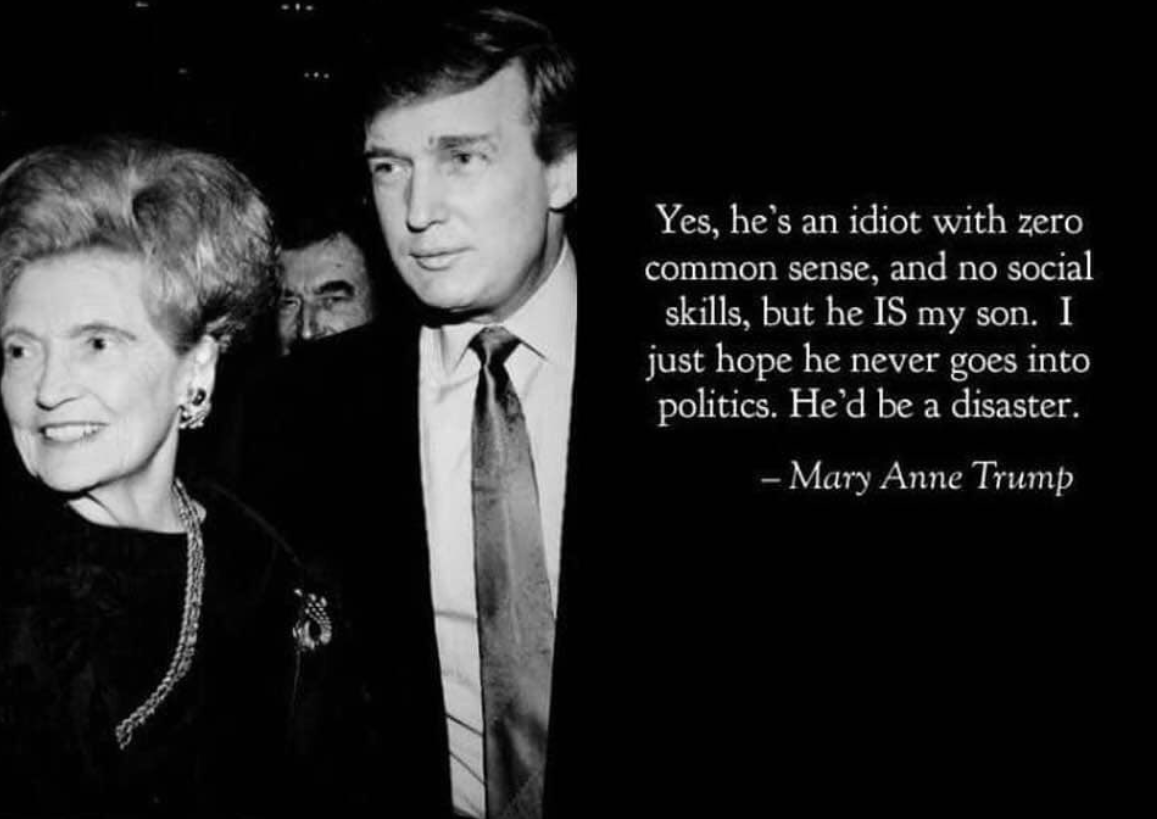
At a meeting last Wednesday, a friend shared an image of a newspaper or magazine clipping with a picture of Donald Trump with his mother, and under the picture a caption quoting his mother saying, "Yes, he's an idiot with zero common sense, and no social skills, but he IS my son. I just hope he never gets into politics. He'd be a disaster."

Preparatory to sharing this, I figured people would like to know which publication it's from. So I did a Web search for "Mary Anne Trump" + "idiot." And what I got was a bunch of pages calling it fake news because they say the quote couldn't be found in any media searches.
Curiously, though, they all show a different meme from the one above -- something much more easily photoshopped, and therefore much more easily dismissed as fake. I was going to post that image below but, strangely, every time I try to do so I get an error message saying the file "must be an image or video," the first of which is exactly what it is. But you can see it here: https://www.snopes.com/tachyon/2019/12/mary-anne-trump.png
Concerning searches for the quote, my friend remarks, "Well upon further review it is not likely a newspaper clipping. More likely a magazine. If they searched newspapers and didn’t find it they would get a false negative. To date it I would suggest it’s mid-80’s, a long time before real online archives that include both pictures AND captions. It’s not formatted like a pull quote so it probably wasn’t in the story."
If anyone reading this knows where the first image is from, please respond in the comments.
This is an unprecedented situation: two exceptionally incompetent capitalist politicians competing to be head of what's increasingly looking like a failed state as a pandemic rages out of control and many think we're on the verge of civil war.
Unlike the previous one, there's no revolutionary class with the consciousness to give it a progressive resolution. The working class still doesn't even have our own party. Yet if socialists just continue operating as usual, following our customary symbolic electoral practices while waiting for that to happen, things could get much worse.
In this context, I'm supporting a different approach -- one that buys time for an ultimate socialist solution by avoiding the more immediate existential threat from a totally dysfunctional political system. I'm supporting Unity2020.
It's not a left campaign. It's more like an anti-corruption, pro-competence campaign. Its merit is that it may not only halt the course toward self-destruction we're currently on -- it may open up new possibilities by breaking the grip of the two capitalist parties and, by doing so, set an example that could finally make a workers' party look like a realistic idea to millions of people.
It avoids the spoiler problem by defining itself in terms of universal values instead of ideological or demographic checklists. So it draws support away from both capitalist parties equally rather than helping one of them over the other. This is already demonstrated by the composition of volunteers, who include as many conservatives as liberals or progressives. That's why I think it has a serious chance, this year. It may be a long shot, but it's more realistic than expecting that Howie Hawkins, or any left candidate, will be taking the Oath of Office next January.
Right now we're in the process of selecting a pair of candidates to draft from a shortlist of six, based on nominations (now closed) by the volunteers ourselves. I hope you'll go to https://articlesofunity.org and take a look at it. If you decide it's an idea that makes sense at this moment, you can become part of the process of selecting the ticket.
Ryan McEnroe, a writer in Boston, gives this account of how he got involved in the Unity2020 Presidential Plan to Save the Republic, which I also support:
I don’t know exactly when it happened, but sometime in the last eight years I began to feel an intense fear whenever politics came up. I learned to studiously say nothing. I knew around certain family members not to mention that I agreed with President Obama on many issues. And if I said anything positive about a Republican, I knew I could be risking friendships or even my job.
As DNC backroom deals paved the way for Biden’s nomination just before Super Tuesday, it became clear that, as in 2016, I would again have to vote for the “lesser evil.” So I decided I’m not voting for President this year. I cannot vote for Trump but I cannot bring myself to vote for Biden. My vote won’t make a difference anyway. The corrupt parties always win. They can have the government, I will focus my efforts elsewhere. I give up.
Then about a month ago, I came across the website www.articlesofunity.org. It intrigued me. The idea is to try to bring the country together by joining one left-leaning and one right-leaning candidate on a ticket. Here’s the plan they came up with:
Nominate a ticket with two candidates that meet the following criteria: they must be courageous, they must be capable, and they must be patriotic.
A coin flip will determine which candidate runs as President and which candidate runs as Vice President.
They must agree to work as a team, making all decisions together, wherever possible.
After four years, they switch roles, continuing until one has served twice and is ineligible to serve as President.Just your simple every day plan to overthrow the corrupt two-party system and save the republic. They even have a failsafe to ensure that if it does not look like they can win, they will pull the plug and everyone can return to their corners. I had little confidence it could work, but I thought the website had at least earned my email address.
Over the last month, I slowly became more involved. It started by listening to podcast episodes and Campfire discussions about Unity2020. Then I joined an online discussion forum consisting of thousands of Unity2020 volunteers. I have met hundreds of Unity2020 supporters in the last few weeks. Incredibly, these patriots come from all over the political spectrum, but we get together on Zoom calls and in chat rooms, put aside our differences, and work on a common goal: ensuring our next President is a patriotic functional adult that is not tainted by corruption. I learned that as of last week more than 30,000 people have provided their email address on www.articlesofunity.org. There are more of us than I thought, and that number is growing rapidly every day.
I’m still skeptical the plan can work. There are a million reasons not to try. I think the parties and the media want me focusing on those reasons. I have heard others describe a sort of “learned helplessness” we all feel, and I believe the media and the parties want us to feel it.
But there are also reasons to give it a try. I will finally be able to vote for a competent candidate that I can trust isn’t controlled by donors or the party. I will be able to hold my head up high when I exercise my sacred civic duty on November 3. Unity2020 has offered me a lifeboat, a way to avoid choosing between Joe Biden and Donald Trump.
For the first time in eight years, I have been able to bring up politics with Republican family members, as well as Democratic friends and coworkers, without fear that I will be labeled an extremist or a monster. In fact, many of them have also been intrigued and signed up on www.articlesofunity.org.
If you’re interested, check us out at www.articlesofunity.org. If you believe the future of the republic is at stake, which I do, let’s try to do better than Joe Biden or Donald Trump.
From the World Socialist Web Site. It should be noted that not only are both ruling-class parties ignoring the science of how many deaths will result from premature reopening of schools and non-essential workplaces, they are also ignoring the growing evidence of major long-term health effects on those who "recover."
“Honesty and courage alone can save our wounded, disunited country now. We need the honesty and courage to speak the truth including painful truths that unsettle not only our foes but also our friends and, most especially, ourselves.” – Robert P. George and @CornelWest @ArticlesOfUnity #Unity2020 www.articlesofunity.org
Let's move to reverse the political polarization that leads to demonizing each other as in incidents like this by drafting a unity Presidential ticket so everyone can feel their perspective is being heard.
www.articlesofunity.org
#Unity2020
https://www.thefire.org/student-faces-possible-suspension-fine-for-zoom-background-of-president-trump/ via @TheFIREorg
"A house divided against itself cannot stand." --
Abraham Lincoln, 16th president of the United States
"It starts with listening." -- Cassie Jaye, documentary filmmaker https://articlesofunity.org #Unity2020

"His attempt to commit suicide by leaping from the bridge was defeated by the fact that he was an excellent swimmer." -- Steve Silberman, NeuroTribes: The Legacy of Autism and the Future of Neurodiversity, chapter 8, p. 32 of 37
This evening I completed the Scriptwriting Summer Intensive course offered by Scribe Video Center. Even though it's become apparent that putting my project in its finished form will take a lot more work that I'd anticipated, I'm feeling intellectually engaged and excited, not intimidated.
The lesson urged on conservatives here applies to progressives too, as I've discussed previously (https://stripey7.blogspot.com/2018/08/getting-real-about-scotus.html): you can't reliably predict how justices will decide cases. And even when you get a "win," it's not a durable win if it's based on a tortured interpretation of the law. Real progress on social issues requires winning in the court of public opinion, as reflected ultimately in legislation; trying to get by on litigation alone evokes reactance on the part of the unconvinced majority, creating a needless obstacle to progress. Indeed, I think this is one of the biggest reasons for the culture wars which have played such a major role in retarding the development of working-class consciousness in the US.
https://m.youtube.com/watch?v=s2jf3RHtTyw

Val Wilde has posted an article on the Patheos Friendly Atheist blog titled "Wedding Photographer Sues For 'Artistic Freedom' to Deny Service to Gay Couples." Like many others, her habit of viewing everything through an identitarian lens prevents her grasping the First Amendment issues involved. I try to explain them in my comment, copied below.
https://friendlyatheist.patheos.com/2020/07/03/wedding-photographer-sues-for-artistic-freedom-to-deny-service-to-gay-couples/?utm_medium=email&utm_source=BRSS&utm_campaign=Nonreligious&utm_content=361
Okay, so imagine I'm a photographer and I advertise that I do photographs of graduation ceremonies, including graduations from recovery programs. Now a young man comes to me and says, "I've almost completed this program my pastor recommended to me. In ten days I'll be graduating reparative therapy, freed from homosexuality through Christ, and I'd like to hire you to photograph the ceremony!"
I would feel absolutely entitled to say, "Sorry, you'll have to find someone else. I believe it's a dangerous delusion to think you can change your sexual orientation, and I'm not going to create art promoting the idea that you can."
Now suppose this man sues me, claiming I've discriminated against him based on his identity as a born-again Christian, since I'm willing to take graduation pictures for other people. I defend myself by saying I'm not discriminating against him, I'm discriminating against an idea I don't believe in. After all, I'm perfectly willing to photograph his graduation from other kinds of programs; and if a relative of his asked to commission me to photograph his "ex-gay" ceremony, I'd still refuse, even if the relative isn't born-again herself. So it's the idea I'm discriminating against, not the person.
In defending myself in this way, I'm asserting my First Amendment right to freedom from compelled speech, just as the photographer in this case is (even if he prefers to use the language of religious liberty).
To see this argument presented with more legal precision, read what the First Amendment Lawyers Association had to say about the Masterpiece Cakeshop case:
http://www.scotusblog.com/wp-content/uploads/2017/09/16-111-tsac-first-amendment-lawyers-association.pdf
Someone on Quora asked, "What was your most convincing lie?" Here's the answer I gave (at https://www.quora.com/Whats-your-most-convincing-lie/answer/Eric-Hamell?prompt_topic_bio=1):
Strictly speaking, any lie that is believed is 100% convincing, so all successful lies are equally convincing. So the more interesting question would be, what's the lie I've told that's most impressive for having been believed?
Two stand out. In 2002, I decided to volunteer with the International Solidarity Movement, which tries to help Palestinians survive the effects of occupation by providing nonviolent accompaniment as nationals of powerful states. It was suggested that when volunteers arrived in Israel, they should say they're tourists.
But since I'd never been interested in tourism, I doubted I'd be convincing if I said that.
To avoid raising suspicion, I had decided to bring only non-political reading matter on the trip. It so happened two books I'd purchased recently were on the subject of alleged paranormal phenomena, so I chose them to bring along. Prompted by something my landlord said when I told him this, I also made this my cover story: I had come to the country to do paranormal investigations.
I dressed the part by wearing every suitable button in my possession: Mr. Spock, Men in Black II, and The SETI League. While on the shuttle from the plane to Tel Aviv Airport, a young Israeli told me he agreed with my button. I asked which one and he said, "All of them." I smiled.
When I arrived in the building, sure enough I was approached and asked if I could answer a few questions. So I was taken into a room where two airport police asked me about my plans. It seemed like ten minutes but perhaps only felt that way because I was tense. I made sure to put the book I'd just started reading on a filing cabinet near my seat, with the binding facing the two men. I relished the irony of the title in this context: The Trickster and the Paranormal.
I clearly made them comfortable. Toward the end one of them asked if I could bend spoons. We both laughed as I said, "No, I thought that was what your people did!"
The other time was in 2010, when I was invited to attend a Meetup group's book discussion of Ayn Rand's novella _Anthem_. I'd joined this group online when all I knew was that it described itself as a philosophy club. I had subsequently figured out it was actually an arm of an Internet-based anarcho-capitalist cult called Freedomain Radio, whose leader is known for always trying to persuade followers that their families of origin are "toxic" and should be cut off ("de-FOOed").
Years earlier I'd taken an intellectual interest in Rand's ideas and had read some of her works, including _Anthem_. More recently I'd taken an interest in the ideas of Robert Jay Lifton, considered foundational for the cultic studies field, and it occurred to me that the society depicted in the book illustrates several parts of Lifton's eight-point description of ideological totalism. So I re-read it and composed a review of the book in these terms to present at the meeting. I made enough copies for all who'd RSVPed, plus one for myself to refer to during the discussion.
More than the number who'd RSVPed showed up, however. It was a good thing I'd held on to one copy of the review, because I recognized (from her name and picture on the group's Meetup page) one of those who arrived later as the daughter of one of the de-FOOed parents with whom I was acquainted. She was eager to learn "how to tell who's mind-controlled," and I eagerly gave her the review.
I didn't tell any actual lies at this meeting, but many half-truths. For instance, I truthfully related to Emily how I'd been involved in a socialist political cult in my adolescence. I just didn't mention the part about my still being a socialist. As the conversation splintered and drifted away from the book, it became increasingly indistinguishable from others I'd taken part in, like my atheist Meetup group, and my tension lessened as fitting in became less calculated.
Some months later I learned this local branch of the cult had been discontinued by its organizer. I couldn't tell whether my intervention had contributed to this development, but I like to think it may have, by providing the members with some psycho-education in a context where they weren't defensive since it didn't appear to be aimed at their group. On one subsequent occasion Emily very briefly dropped in on a monthly local meeting of the International Cultic Studies Association (where I'd met the de-FOOed parents) with a bunch of her friends to say hello to her mother; there was no indication whether she recognized me sitting at the same table.
Wednesday's issue of Metro featured an interview with Giorgio Tsoukalos, described as "the leading expert and co-executive producer of the television series 'Ancient Aliens.'" I've written the following letter in response:
"I am dismayed by your uncritical interview with mystery monger Giorgio Tsoukalos in Wednesday's edition. The only reason he sees mysteries is that he doesn't bother to do any actual research, only reading books by other mystery mongers before visiting places.
"Concerning various ancient structures, he says 'many people do not know how they were built,' but as noted in the Wikipedia article on Puma Punku, 'Current understanding of this complex is limited due to its age, the lack of a written record, and the current deteriorated state of the structures due to treasure hunting, looting, stone mining for building stone and railroad ballast, and natural weathering.' In other words, if there's any mystery about these sites, it's the result of human misdeeds, not alien intervention. And if 'you don't make sense of anything' when you visit them, it's only because, like Tsoukalos, you haven't bothered to learn what the real researchers -- scientists -- have already figured out.
"His lack of intellectual seriousness is revealed when he calls the Big Dipper 'a constellation that can hardly ever be seen.' Excuse me, but I've seen it countless times; it's one of the easiest ones to see. And he claims that various 'mysterious' sites are 'millions of kilometers apart.' A million kilometers is more than twice the distance from the Earth to the Moon, so enough said about that.
"Fundamentally, this kind of credulousness reflects a lack of faith in humanity and a childish wish for someone bigger to do things for us. That's the kind of attitude we have to overcome, if we as a species are to overcome the crises we face today."
The point about how the "ancient astronauts" quasi-religion is at odds with humanism was made to me by my father when, as an adolescent, I enthusiastically told him about what I'd read in Erich von Daniken's _Chariots of the Gods?_. I was initially put off by his reaction but later realized the truth of it.
For Fathers' Day, please watch this video and then consider supporting the launch of a Canadian Center for Men and Families in Vancouver! Introducing CCMF Vancouver https://youtu.be/L4jt2QMujr4 via @YouTube

 Posts
All Comments
Posts
All Comments